October 23, 2026
What Evidence Satisfies the Multifactor Authentication Requirement 3.5.3?
Your team turned on MFA across the company, but the assessor still asked for proof. You were not sure which files and records count as evidence for requirement 3.5.3.
NIST is the National Institute of Standards and Technology. CUI is Controlled Unclassified Information. MFA means multifactor authentication: proving identity with two or more different factors. A privileged account has elevated rights, like an administrator account. A nonprivileged account is a normal user account without those rights.
What the requirement says
NIST SP 800-171 Rev 2 sets requirement 3.5.3 NIST SP 800-171 Rev 2. The requirement text is:
Use multifactor authentication for local and network access to privileged accounts and for network access to nonprivileged accounts.
MFA needs two or more of three factor types: something you know, something you have, or something you are. A password is something you know. A hardware token is something you have. A fingerprint is something you are NIST SP 800-171 Rev 2.
The standard says you do not need a government smart card. Commercial tools such as authenticator apps and hardware keys satisfy the requirement NIST SP 800-171 Rev 2.
Local access means sitting at the machine, with no network in between. Network access means access through any network, including the internet NIST SP 800-171 Rev 2.
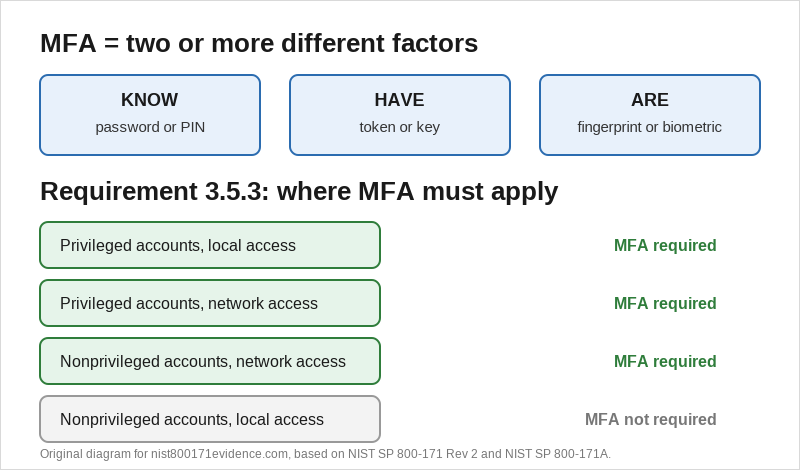
NIST SP 800-171A breaks the requirement into four objectives the assessor must confirm. First, your privileged accounts are identified. Second, MFA is enforced for local access to those accounts. Third, MFA is enforced for network access to those accounts. Fourth, MFA is enforced for network access to nonprivileged accounts NIST SP 800-171A.
What the assessor wants to examine
Assessors start with documents, following the examine method in NIST SP 800-171A NIST SP 800-171A. They examine the identification and authentication policy to see MFA stated as required. They read procedures for enrolling users, replacing lost tokens, and removing access. They check the security plan, which describes how each system enforces MFA. They review configuration exports, such as conditional access policies, that show MFA is turned on. They inspect the list of system accounts to confirm privileged accounts are identified. They sample audit and sign-in logs to confirm MFA challenges appear in real logins. They also look for an MFA registration report and a list of any exempt accounts with written approval.
Every exception needs written approval with a date and a named approver. An undocumented exception reads as a gap, not as a decision.
What the assessor asks in interviews
Interviews confirm the documents match reality. Expect questions like these, asked of administrators, account managers, and security staff NIST SP 800-171A:
- How do you identify which accounts are privileged?
- Walk me through enrolling a new hire in MFA.
- What happens when someone loses their token?
- Which accounts are exempt from MFA, and who approved that?
- How do you remove MFA access when someone leaves?
If your answers differ from your written procedures, the finding follows the weaker of the two. Train the people who will sit in those interviews before assessment day.
What the assessor tests
Testing checks that MFA actually blocks logins, not just that it is configured NIST SP 800-171A. The assessor may try a password-only login on a privileged account. They expect an MFA prompt before access is granted. They may try a network login on a normal user account with no MFA enrolled. They expect that attempt to fail. They may also verify that a local administrator login on a server requires a second factor.
Run these tests yourself before the assessor does. A failed self-test is a fix you can make in private.
The evidence folder a small company can keep
Keep one folder per requirement. For 3.5.3, yours can look like this:
/mfa-evidence-3-5-3
  identification-authentication-policy.pdf
  mfa-enrollment-procedure.pdf
  account-list.xlsx
  mfa-registration-report.pdf
  conditional-access-exports/
  sign-in-log-samples/
  approved-exceptions.xlsx
Refresh the account list and registration report every month. Keep sign-in log samples from the most recent 30 days. File every exception approval the day it is granted.
The Department of Defense assessment methodology scores requirement 3.5.3 at three to five points. Missing MFA entirely costs five points. Covering remote and privileged users but not the general population costs three. MFA is one of the few requirements where the methodology builds in partial scoring. Most other requirements are scored met or not met NIST SP 800-171 DoD Assessment Methodology 1.2.1.
Next step
PolicyCortex reads your live Azure configuration. It turns that evidence into System Security Plan, Security Assessment Report, and Plan of Action and Milestones documents. See how your MFA evidence holds up today: PolicyCortex.