October 22, 2026
UpdraftCentral Is an Incident Response Evidence Test
NIST 800-171 practice 3.6.1 expects an incident handling capability. It means preparation, detection, analysis, containment, recovery, and user response. UpdraftCentral exercised all six.
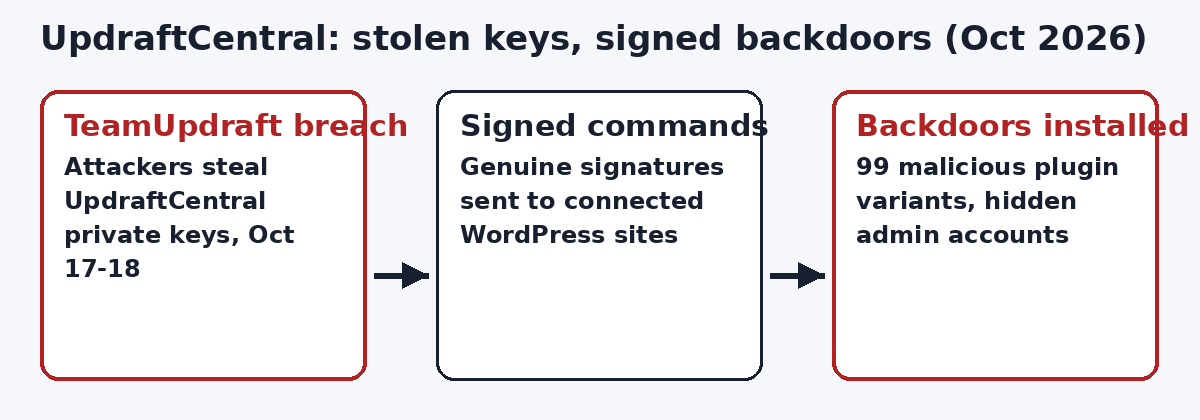
Over the weekend of October 17 and 18, 2026, attackers broke into TeamUpdraft's website. They stole the customer database and the private keys behind UpdraftCentral, the remote management service for UpdraftPlus, the most popular WordPress backup plugin.
The attackers sent commands to connected sites. The commands installed backdoor plugins. The signatures were real, so every check passed. Security firm Nethemba found the campaign on its own servers. Security firm Patchstack counted 99 malicious plugin names installed between 15:32 UTC on October 18 and 09:23 UTC on October 19.
Detection
Practice 3.6.1 starts with detection. Nethemba detected the attack because a command arrived signed by keys that had never lived on its servers.
Your detection evidence should show how you would notice the same. Do you inventory the plugins on your WordPress sites? Do you alert on new admin accounts? Do you review login cookies that skip the login form?
One recurring backdoor used the description "Small maintenance toolkit: keeps option storage tidy." If your logs cannot answer whether that plugin exists on your sites, detection is a gap.
Analysis and containment
Patchstack's analysis showed the backdoor creates a hidden account and a persistent login cookie. Removing the plugin alone does not remove the account.
Containment evidence for this incident has three parts. The key inventory: which systems held a live UpdraftCentral key. The compromise check: unknown plugins, accounts, and cookies. The remediation: the update, the key rotation, and the manual deletions.
The audit link
Practice 3.3.1 expects audit records of system activity. The researchers reconstructed the campaign window from logs. Your systems should let you do the same: which commands arrived, when, and from which keys.
Keys created between 12:07 and 21:00 UTC on October 18 survive the vendor's update. They must be deleted by hand. Your audit trail should show the deletion.
What to do this week
Search for unknown plugins and accounts. Update to UpdraftPlus 1.26.13 or Premium 2.26.13. Delete keys in the manual window by hand.
Then write the after action note. What detected it, what was checked, what was removed. That note is the evidence practice 3.6.1 expects.
Sources
- Security incident disclosure, TeamUpdraft, October 19, 2026. Vendor's primary incident statement.
- "Stolen UpdraftCentral Keys Are Backdooring WordPress Sites," Patchstack, October 19, 2026. https://patchstack.com/articles/updraftcentral-key-compromise-wordpress-backdoors/
- Campaign analysis, Nethemba, October 19, 2026. First detailed researcher analysis of the campaign.
- NIST SP 800-171 Revision 2, Protecting Controlled Unclassified Information. https://doi.org/10.6028/NIST.SP.800-171r2
- Original diagram by PolicyCortex.
Next step
Want incident evidence collected from the live system instead of assembled by hand? See how PolicyCortex collects it on Azure.