October 22, 2026
PwnEscape Is a Flaw Remediation Evidence Test
NIST 800-171 practice 3.14.1 is short. Identify, report, and correct information and system flaws in a timely manner. PwnEscape is the case study.
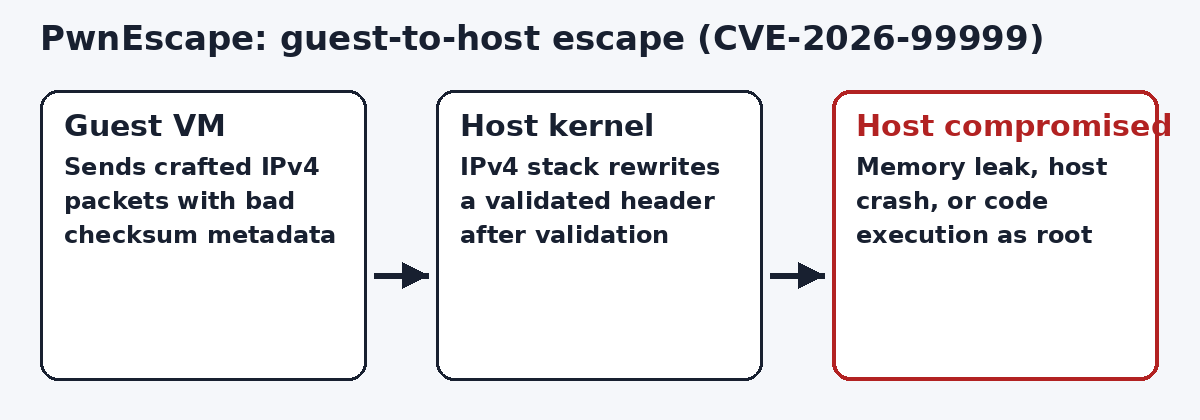
CVE-2026-99999 is a flaw in the Linux kernel's IPv4 stack. A guest virtual machine (VM) sends crafted packets with bad checksum metadata. The host kernel rewrites a validated header after validation. The guest reaches the host: memory leaks, crashes, and code execution as root. The Linux kernel security team rates it 9.3, Critical.
The flaw sits below the hypervisor in the host kernel. Patching guests does nothing. The host kernel must be updated.
Identify
Identification starts with knowing your host layer. The CVE record lists kernels from 2.6.27 through the fixed point releases. Fixed versions include 5.10.272, 5.15.223, 6.1.190, 6.6.159, 6.12.113, 6.18.57, and 7.2.11.
A vulnerability scan that stops at guest images misses this class of flaw. Identification evidence should show the scan scope includes host kernels and hypervisors.
Report
Reporting means the flaw enters your tracking with a severity and a clock. A 9.3 Critical flaw gets the fastest timeline your policy defines.
The record for this one should note the disclosure dates: privately reported September 4, 2026, published October 15, updated October 19. It should note the exploitability. A guest-to-host escape means any tenant workload is a potential attacker.
Correct
Correction is the patch plus the proof. The proof is the host kernel version after the update and the verification that the vulnerable code path is gone.
Keep the evidence together: the CVE record reference, the affected host list, the patch dates, and the post-patch scan. An assessor wants the chain from identification to correction, not four separate files.
The configuration management link
Practice 3.4.1 expects a baseline configuration. Host kernels belong in that baseline. If your baseline lists guest images but not host kernels, PwnEscape is the reason to fix the baseline.
Baseline evidence that names the host layer makes every future flaw in that layer a routine event. Missing it makes every one a scramble.
What to do this week
Pull the host kernel versions from every virtualization and container host. Compare against the fixed versions. Patch and verify.
Then open your baseline and your scan scope. If the host layer is absent from either, add it now.
Sources
- CVE-2026-99999 record, CVE Program. Published October 15, 2026, updated October 19, 2026. CVSS 3.1 base score 9.3, Critical.
- PwnEscape technical writeup, pwn.ai. https://pwn.ai/blog/pwnescape
- NIST SP 800-171 Revision 2, Protecting Controlled Unclassified Information. https://doi.org/10.6028/NIST.SP.800-171r2
- Original diagram by PolicyCortex.
Next step
Want flaw evidence collected from the live system instead of assembled by hand? See how PolicyCortex collects it on Azure.