October 21, 2026
Detecting Plex2Shell Maps to 800-171 Monitoring and Malicious Code Controls
Patching Plex2Shell closes the hole. Detecting what came through it is a different job. NIST 800-171 names both.
On October 20, 2026, CISA added four Plex Media Server flaws to its Known Exploited Vulnerabilities catalog. The flaws are CVE-2026-96652, CVE-2026-96654, CVE-2026-96655, and CVE-2026-96656. (CISA alert) Attackers used the chain to drop a cryptocurrency miner and proxy software on compromised servers.
The miner and the proxyware are the malicious code your controls are supposed to catch.
Which practices cover detection
NIST SP 800-171 practice 3.14.2 asks you to provide protection from malicious code. Practice 3.14.6 asks you to monitor systems and incoming and outgoing communications for unusual activity. Practice 3.14.7 asks you to identify unauthorized use of systems.
A Plex2Shell breach trips all three. The payload is malicious code. The miner burns CPU at odd hours. The proxy software sends traffic the owner never requested.
What the signs look like
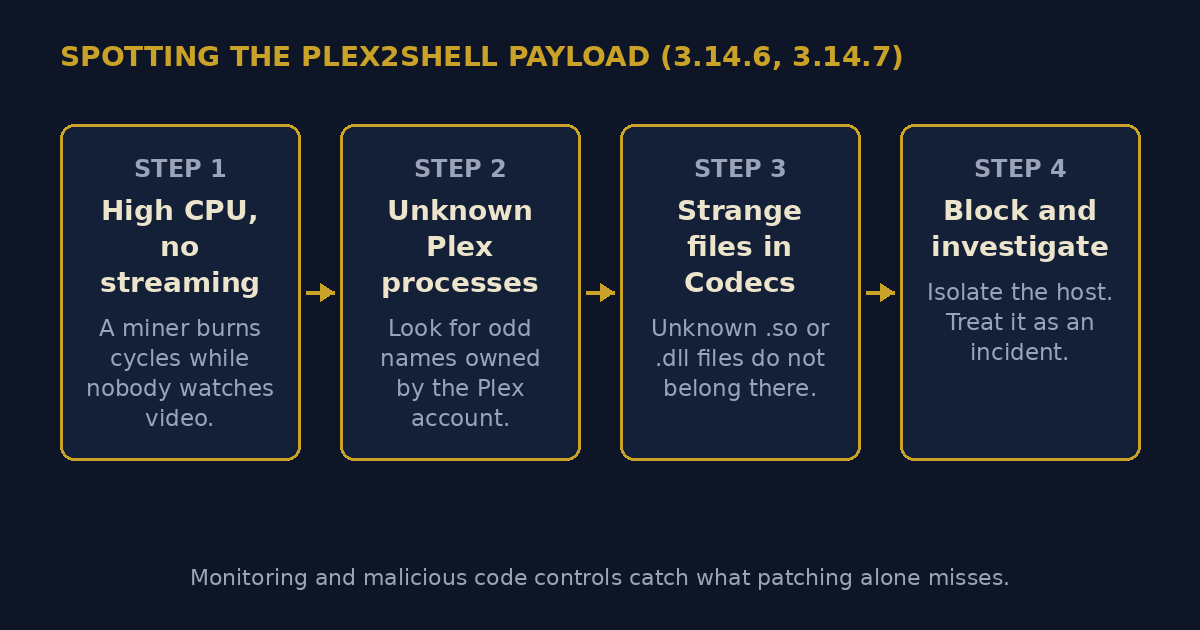
The reported payloads have names. Look for processes called mylovelyminer, x12345, or myawesomeproxy owned by the Plex account. Look for unknown .so or .dll files in the Plex Codecs folder.
The behavioral signs matter more. The processor stays high while nobody streams. Outbound connections go to mining pools or unknown relay domains. Transcoder settings changed without an admin doing it.
These are the unusual activities practice 3.14.6 is written for.
The evidence an assessor wants
Logs with dates. Process lists captured during the incident. The monitoring alerts that fired, or the gap where none did.
If your monitoring caught the miner, keep the alert and the response record. If it did not, that gap is a finding to fix, not a secret to hide. Practice 3.14.7 asks you to identify unauthorized use. A miner running for a month is unauthorized use your monitoring missed.
What to do this week
Check every host that ran Plex Media Server below build 1.43.3.10861. Look for the process names and files above. Review processor and outbound traffic history for the past month.
Write down what you checked and what you found. That record is the evidence, whether the answer is clean or not.
Sources
- CISA Adds Six Known Exploited Vulnerabilities to Catalog, CISA, October 20, 2026. https://www.cisa.gov/news-events/alerts/2026/10/20/cisa-adds-six-known-exploited-vulnerabilities-catalog
- CVE-2026-96656 record, CVE Program. https://www.cve.org/CVERecord?id=CVE-2026-96656
- NIST SP 800-171A, Assessing CUI Requirements. https://nvlpubs.nist.gov/nistpubs/SpecialPublications/NIST.SP.800-171Ar3.pdf
- Original diagram by PolicyCortex.
Next step
Want monitoring evidence pulled from your live systems on a schedule? See how PolicyCortex collects it on Azure.