October 24, 2026
You Patched PHP. Did You Hunt? What CISA Added on October 23
Your PHP patch is in, but your evidence is not done yet.
What changed on October 23?
The Cybersecurity and Infrastructure Security Agency (CISA) updated its PHP alert on October 23, 2026. The update adds a SIGMA detection rule for suspicious activity. A SIGMA rule is a detection rule you run against logs. CISA says the rule helps find suspicious activity in relevant log sources.
The same day, the Federal Bureau of Investigation (FBI) issued a formal alert. It came through its Internet Crime Complaint Center (IC3). The alert follows the FBI social media post from October 21. It warns that the same two flaws can let attackers run code in PHP core. Both updates point past the patch and toward the hunt.
Which flaws are these?
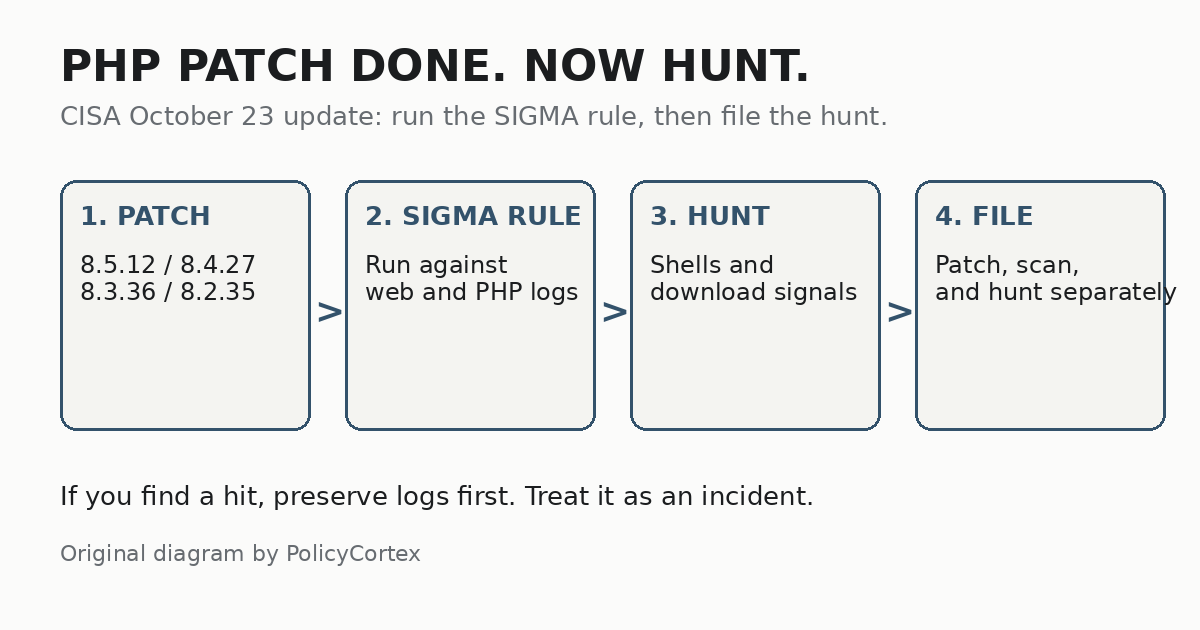
The flaws are CVE-2026-109618 and CVE-2026-109619. They are known as PHP2Shell. Both allow unauthenticated remote code execution in PHP. Unauthenticated means no login is needed first. They affect all PHP installations serving web requests. That includes Apache with mod_php, PHP-FPM, php-cgi, FrankenPHP, and LiteSpeed. PHP calls Apache with mod_php the highest risk setup. Fixed versions are PHP 8.5.12, 8.4.27, 8.3.36, and 8.2.35. PHP 8.1 and older get no official fix from PHP. CISA says to take those systems offline until they can be patched or updated.
What does the hunt look like?
Run the CISA SIGMA rule against your web and PHP logs. Save the rule version and the run date with your evidence. Look for PHP worker processes launching shells or downloading tools. That signal is the one CISA names in its alert. Check web roots for files you did not put there. Check for new admin accounts and changed files after the patch date. A clean patch with no hunt is a gap, not proof. If you find a hit, treat it as an incident, not a patch task. Preserve the logs before you rebuild or clean anything.
How does this map to NIST 800-171?
NIST is the National Institute of Standards and Technology. Its publication SP 800-171 sets the rules for protecting Controlled Unclassified Information (CUI). Requirement 3.14.1 covers flaw remediation. It asks you to identify, report, and correct flaws in a timely manner. Your patch record satisfies that requirement. Requirement 3.6.1 covers incident handling. Your hunt record satisfies that requirement. Requirement 3.11.2 covers vulnerability scans. Your scan before and after the patch satisfies that requirement. File the patch, the scan, and the hunt as three separate items. An assessor can then follow each step in order.
What to do this week
- Confirm the running PHP version on every web server.
- Run the CISA SIGMA rule and file the output.
- Review shell and download signals in PHP worker logs.
- List every unpatched PHP system and take it offline or patch it.
- Record the owner and the date for each open item.
Sources
- Critical Vulnerabilities in PHP Require Immediate Patching, CISA, updated October 23, 2026
- Critical Vulnerability Alert: PHP Core, FBI IC3, PSA261023
- CVE-2026-109618 record, CVE Program.
- CVE-2026-109619 record, CVE Program.
- NIST SP 800-171 Revision 2, Protecting Controlled Unclassified Information. https://doi.org/10.6028/NIST.SP.800-171r2
- Original diagram by PolicyCortex.
Next step
Want requirement evidence pulled from live systems? See how PolicyCortex maps each control to its proof.