October 22, 2026
Requirement 3.13.1, Requirement 3.14.1, and a Backup Server Attackers Already Own
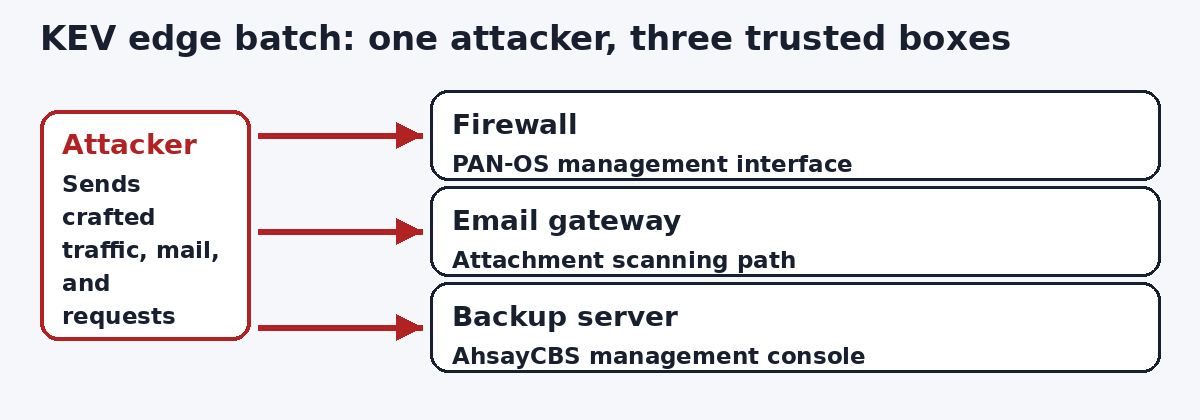
National Institute of Standards and Technology (NIST) Special Publication 800-171 has two nearby requirements. Requirement 3.13.1 covers boundary protection for your systems. Requirement 3.14.1 covers timely correction of system flaws. This month, one alert tests both at once.
The Cybersecurity and Infrastructure Security Agency (CISA) acted on October 14, 2026. It added four flaws to the Known Exploited Vulnerabilities (KEV) catalog. Each flaw had evidence of active exploitation behind it.
Boundary protection, requirement 3.13.1
Requirement 3.13.1 asks you to monitor and control boundary communications. It also asks you to protect the confidentiality of Controlled Unclassified Information (CUI) in transit. Firewalls and mail gateways do much of that work.
CVE-2026-0322 weakens the firewall doing the controlling. It allows root code execution in the PAN-OS management interface. The score is 8.6 on the Common Vulnerability Scoring System (CVSS).
CVE-2026-76519 weakens the gateway watching inbound mail. It allows root commands from one crafted attachment. The score is 9.8, and no account is needed.
When the boundary tool is the weak point, say so. Your assessment record should name that plainly. Hiding it inside a general patch note helps nobody.
Flaw remediation, requirement 3.14.1
Requirement 3.14.1 asks you to identify, report, and correct flaws promptly. Promptly is your defined period, until exploitation starts. Active exploitation shrinks any honest period to days.
For Cisco, prompt means updating Content Scanner Tools to 25.3.0.5525. For Palo Alto Networks, prompt means a listed fixed PAN-OS release. For Ahsay, prompt means the second round hotfix, not the first. Write the exact build into your flaw record.
The backup server problem
CVE-2026-105133 bypasses authentication inside Ahsay AhsayCBS. CVE-2026-105134 then injects operating system commands. Huntress saw that chain used from October 7, 2026.
A backup server is not a side system here. It stores copies of the information you protect. It often holds credentials for many other systems. SYSTEM access there can reach far past one server.
Treat its flaw record as a boundary record too. Note its network exposure in the same entry. Note who could reach its console from outside. Note the rebuild decision if compromise signs appear.
PolicyCortex does not patch these appliances. Your team applies the vendor hotfix and records it. PolicyCortex helps keep that record current and findable.
What to do this week
Map each affected product to 3.13.1 or 3.14.1. Some products will honestly map to both requirements. Record the build, the fix date, and the exposure note. Keep the record where assessors will actually look.
Sources
- CISA alert, CISA Adds Four Known Exploited Vulnerabilities to Catalog, October 14, 2026. https://www.cisa.gov/news-events/alerts/2026/10/14/cisa-adds-four-known-exploited-vulnerabilities-catalog
- CVE-2026-0322 record, CVE Program. Palo Alto Networks advisory at https://security.paloaltonetworks.com/CVE-2026-0322
- CVE-2026-76519 record, CVE Program. Cisco advisory cisco-sa-esa-afw-zqYJkjxp.
- CVE-2026-105133 and CVE-2026-105134 records, CVE Program. Huntress report at https://www.huntress.com/blog/ahsaycbs-flaws-exploit
- NIST Special Publication 800-171 Revision 2. https://doi.org/10.6028/NIST.SP.800-171r2
- Original diagram by PolicyCortex.
Next step
Want each flaw record linked to its 800-171 requirement automatically? See how PolicyCortex keeps that mapping current.