November 01, 2026
How Do I Handle Assessment Objectives I Cannot Safely Test on Live Systems?
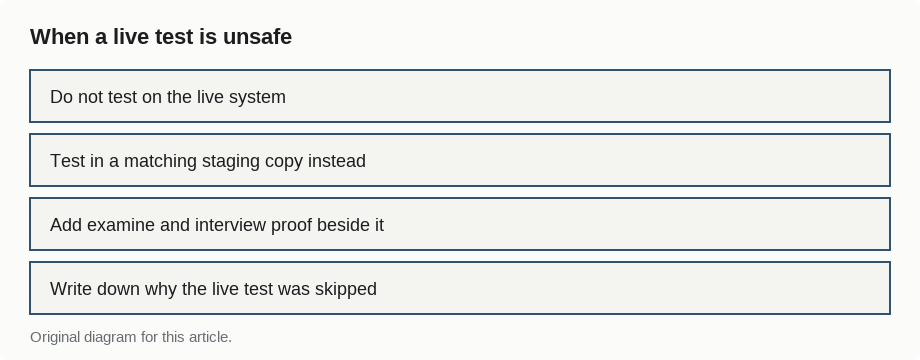
Some tests would break the live system if you ran them there. A failover test can drop real users. A restore test can overwrite real data. A good assessor does not want you to cause harm to prove a point.
NIST SP 800-171 sets the security requirements for protecting CUI. CUI means Controlled Unclassified Information. NIST means National Institute of Standards and Technology. NIST SP 800-171A gives assessors three methods. Examine means reviewing records and documents. Interview means talking with staff who run the control. Test means exercising a control under set conditions and comparing the result with the expected result. Not every objective needs all three methods. Each objective lists the methods that fit it.
Start by naming the risk honestly
Write down why the live test is unsafe, in one short paragraph. Name the system part at risk. Name the harm that could follow. Name the users or data that could be affected. A vague note like "too risky to test" helps no one. A specific note lets the assessor judge the call for themselves.
Do this early, before assessment week. An assessor who first hears about a skipped test on assessment day will doubt the whole objective. An assessor who sees the note and the substitute proof in advance can plan around it.
Use a matching staging copy for the test
The strongest substitute is a test in a staging copy that matches live settings. Build the copy from the same configuration as the live system. Run the test there. Record the test steps, the result, and the date. Then record how you confirmed the staging copy matches live settings. A staging copy with different settings proves nothing about the live system.
If you have no staging copy, say so plainly. Do not pretend a paper review is a test. A paper review is examine evidence, and it is still useful. It just covers a different method than a test, and the assessor should see it labeled correctly.
Add examine and interview proof beside the test
Substitute proof works best as a set, not a single item. Add the design document that describes how the control should work. Add change records that show the control was built as designed. Add logs that show the control running in normal use. Interview the staff who operate the control, and record what they describe. If documents, logs, and staff tell the same story, the case is strong. That holds even without a live test.
Label each item with the method it covers. Mark design documents as examine. Mark staff talks as interview. Mark staging results as test, with a note that the test ran outside live systems. Clear labels help the assessor map your proof to each objective without guessing.
Do not mark what you cannot support
Never mark an objective satisfied on a guess. If substitute proof covers only part of an objective, say which part is covered. Say which part stays open. Put the open part in your POA&M. POA&M means Plan of Action and Milestones. An honest partial result with a fix plan beats a confident mark that falls apart under questions.
Read only checks deserve care too. A read only config check is examine evidence, not test evidence. It shows the setting at one moment. It does not show the control acting under load or failure. Do not dress up a config check as a test. Assessors know the difference, and the mismatch hurts your credibility on other objectives too.
Agree the approach before assessment day
Send the assessor your list of untestable objectives early, with the reason and the substitute proof for each one. Ask if the approach is acceptable. If the assessor wants a different substitute, you still have time to build it. If you wait until the assessment, a rejected approach leaves no time to recover. Early agreement turns a hard objective into a planned one.
Next step
PolicyCortex collects evidence from live Azure configuration using 33 collectors. The collectors read conditional access, diagnostic settings, Defender posture, backup, and firewall. The evidence is evaluated against NIST 800-53 and NIST 800-171. It supports re-verification after remediation. It generates SSP, SAR, and POA&M output from collected evidence. SAR means Security Assessment Report. SSP means System Security Plan. PolicyCortex is strongest in commercial Azure, and AWS is covered. Start at https://policycortex.com.
Sources
- NIST SP 800-171 Revision 2, Protecting Controlled Unclassified Information in Nonfederal Systems and Organizations, National Institute of Standards and Technology. https://doi.org/10.6028/NIST.SP.800-171r2
- NIST SP 800-171A, Assessing Security Requirements for Controlled Unclassified Information, National Institute of Standards and Technology. https://nvlpubs.nist.gov/nistpubs/SpecialPublications/NIST.SP.800-171a.pdf